

How Do Sand-Free Towels Actually Work?
TL;DR: Sand-free towels work because of their weave, not a coating or a trick. Tightly woven microfibre has a smooth, grid-like surface with no loops for sand to lodge in, so it slips off with a shake, wet or dry. The same tight weave is why they absorb fast and dry in about half the time of a regular towel.
By Laura & Michael, founders of Sand Society. We spent 18 months developing our fabric; this is what we learned.
If you've ever shaken a cotton towel over the car boot and watched half the beach fall out, you know the problem. Here's the fix, in plain words.
The short answer: it's the weave, not magic
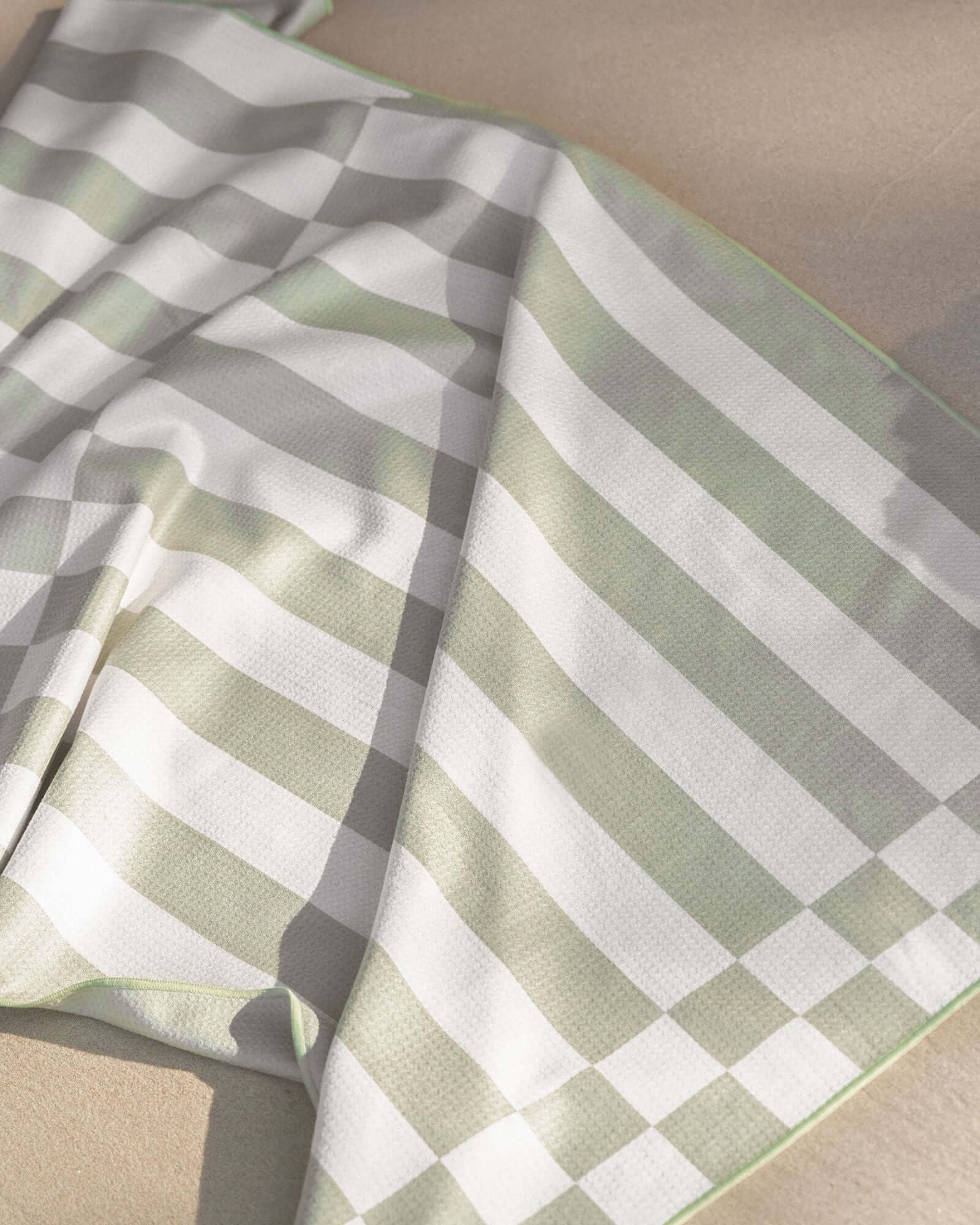
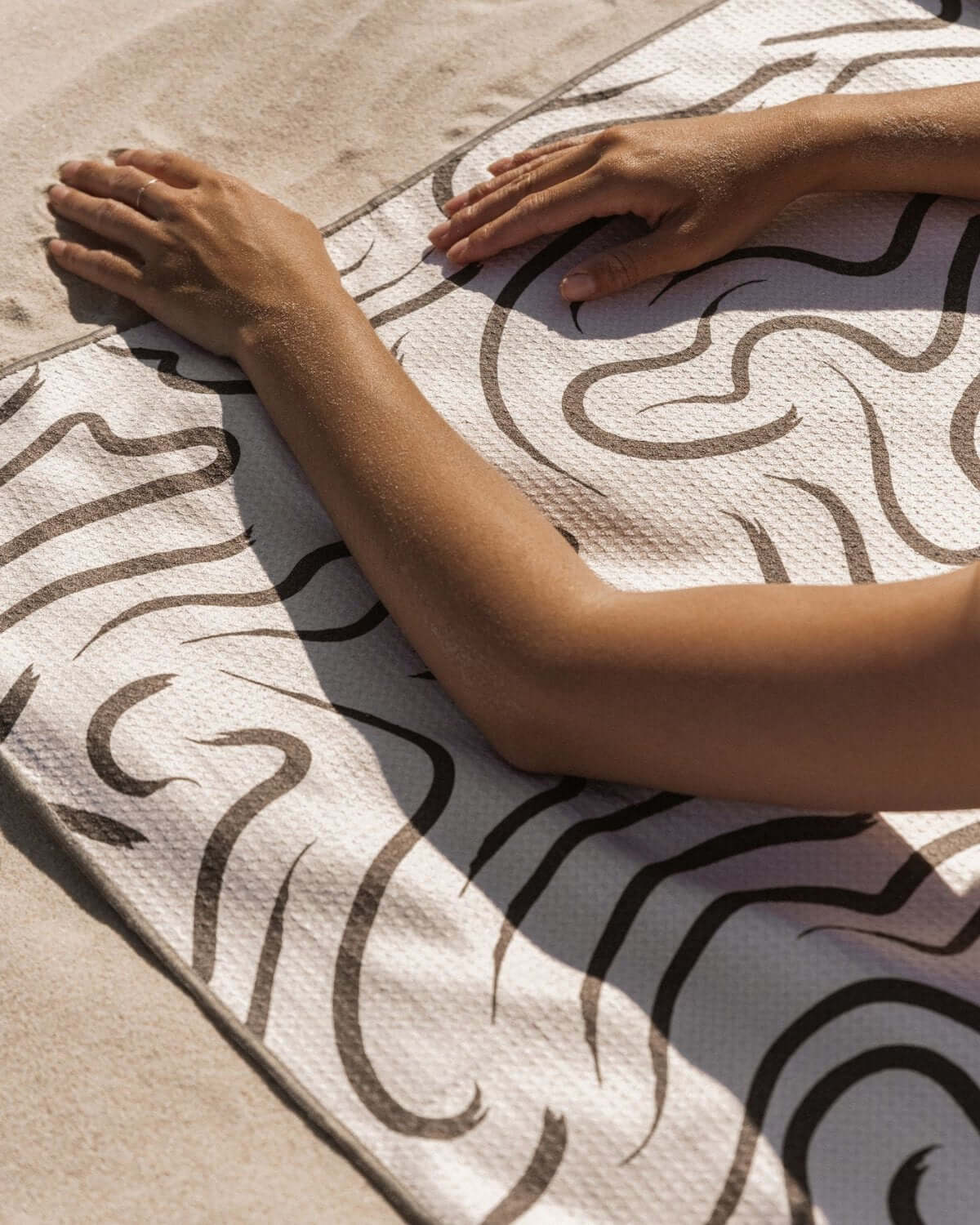
A sand-free towel (you'll also see them called sand-proof towels, no-sand towels or sandless towels) is made from microfibre woven so tightly that the surface is smooth and grid-like. Sand has nowhere to sink in. It sits on top, and one shake sends it back where it belongs. We call it leaving the beach at the beach.
Nothing is sprayed on and nothing wears off. The behaviour is built into the fabric, so it keeps working wash after wash.
Why your cotton towel brings the beach home
Hold a regular cotton towel up close and you'll see thousands of tiny loops. That's terry cloth, and the loops are why cotton feels plush and absorbs well. They're also tiny pockets, each about the right size to catch a grain of sand.
Dry sand falls in and stays. Wet sand is worse, because moisture glues the grains into the pile until laundry day. That's the towel you shake four times and still find gritty on the back seat.
What a sand-free weave does differently
Sand-free microfibre flips the structure. The fibres are far finer than cotton and woven flat and tight, so the surface is a smooth grid rather than a field of loops.
- Dry sand can't lodge between the fibres, so it slides straight off when you lift the towel.
- Wet sand sits on the surface until the moisture wicks away, then brushes off with your hand or a shake. It never bonds into the fabric the way it does with terry loops.
All of it comes down to how tightly the fabric is woven.

Why the same weave dries fast and still absorbs
A tight weave sounds like it should push water around rather than soak it up. It does the opposite. Microfibre absorbs by drawing water into the spaces between very fine fibres, and thin fibres pack an enormous amount of surface area into the fabric.
Ours is double-sided and roughly 2 to 3 times thicker than a typical microfibre towel, which is how a 160 x 80cm towel absorbs up to 1L of water yet dries in about half the time of a regular towel. You get a proper dry after a swim, and a towel that's ready again before you've packed the car.
It's also why it stays light in your bag. Lightweight, quick-dry, sand-free: the three things a beach towel is actually asked to do. The full fabric breakdown lives on our towel tech page.
From 20+ recycled bottles to the towel in your bag
Every Sand Society towel starts life as more than 20 recycled plastic bottles. They're collected, cleaned and shredded into flakes, melted into pellets, then drawn out into fine fibre that's spun into yarn and woven into the fabric above.
Recycled microfibre performs the same as new. The difference is that those bottles never reach landfill or the ocean we swim in. More on our sustainability and values page.
Cotton terry vs sand-free microfibre
| Cotton terry towel | Sand-free recycled microfibre | |
|---|---|---|
| Surface | Open loops that trap sand | Smooth, tight, grid-like weave |
| Sand | Comes home with you | Shakes off at the beach |
| Drying time | Slow, damp by day's end | About half the time of a regular towel |
| In the bag | Heavy, worse when wet | Lightweight, folds into its carry pouch |
| Made from | Cotton | 20+ recycled plastic bottles per towel |
What "sand-free" doesn't mean
Fair's fair: no towel repels sand mid-air. Lie on one at the beach and there will be sand on it when you stand up. The difference is what happens next: one shake and it's gone, instead of riding home in the fibres, the car and the washing machine.
So "sand-free" means sand doesn't stick. The weave gives it nothing to grip. If you're weighing up whether that's worth paying for, we've tackled exactly that question in are sand-free towels really worth it?
How to care for a sand-free towel
- Shake it out at the beach. Most of the job is done right there.
- Machine wash cold on a gentle cycle.
- Skip fabric softener. It coats the fibres and kills absorbency.
- No bleach, no ironing. High heat and fine fibres don't mix.
- Line dry. It will beat everything else on the line anyway.
Sand-free towel FAQs
Do sand free towels really work?
Yes. The tight microfibre weave gives sand nowhere to lodge, so it shakes off, wet or dry. It's fabric structure rather than a coating, so it doesn't wear off. You do still need to give it a shake.
Do sand free towels work with wet sand?
They do. Wet sand sits on the surface rather than bonding into the fibres, so once the moisture wicks away it brushes straight off. Cotton terry, by contrast, holds wet sand in its loops until wash day.
Are sand free towels good for swimming?
They're made for it. Ours absorb up to 1L of water, dry in roughly half the time a regular towel needs, and pack into a carry pouch, which makes them a favourite for swim squads, ocean pools and after-school lessons.
How do you wash a sand free towel?
Shake the sand off first, then machine wash cold on a gentle cycle and line dry. Skip fabric softener and bleach: softener coats the fine fibres and reduces absorbency.
What's the difference between a sand free towel and a regular microfibre towel?
The weave and the build. Sand-free towels use a tighter, smoother weave so sand can't lodge in. Ours are also double-sided and roughly 2 to 3 times thicker than typical microfibre, so they feel like a towel rather than a chamois.
Ready to try one?
Our sand-free beach towels are made from 20+ recycled bottles each and designed on the Northern Beaches. Browse the full range of sand-free beach towels; the first shake-out over dry sand will make the case better than we can. Easier, cleaner, more enjoyable.